Showing posts with label Bushcraft. Show all posts

Monday, July 13, 2015

Summer Wild Edibles and Wild Brew! Woohoo!

After a break to accommodate real life and my addictions to pick-your-own farms and canning, I finally made it back to one of Tim MacWelch's (@timmacwelch) wild edibles classes and a wild brewing class. This time I dragged my daughter along as well. (Okay, getting a 22-year-old to a brewing class didn't require much dragging.)

Dried Sassafras Leaves
Of the edibles classes so far, the summer class was one of the best and I have to credit the blackberries. I love summer fruits and I'd have been perfectly happy if all we did was park in front of the blackberry bramble to graze.

It was a large class, but we were still able to cover a lot of ground. I know. I have the step count on my pedometer to prove it. I learned a few new plants and was able to identify a few that changed their appearance for summer.

I also got to bring home some sassafras from the Wild Brew class and I dried the leaves and will go into some stew or gumbo this fall. The roots will most likely end up in a soda or an ale. I haven't decided yet.

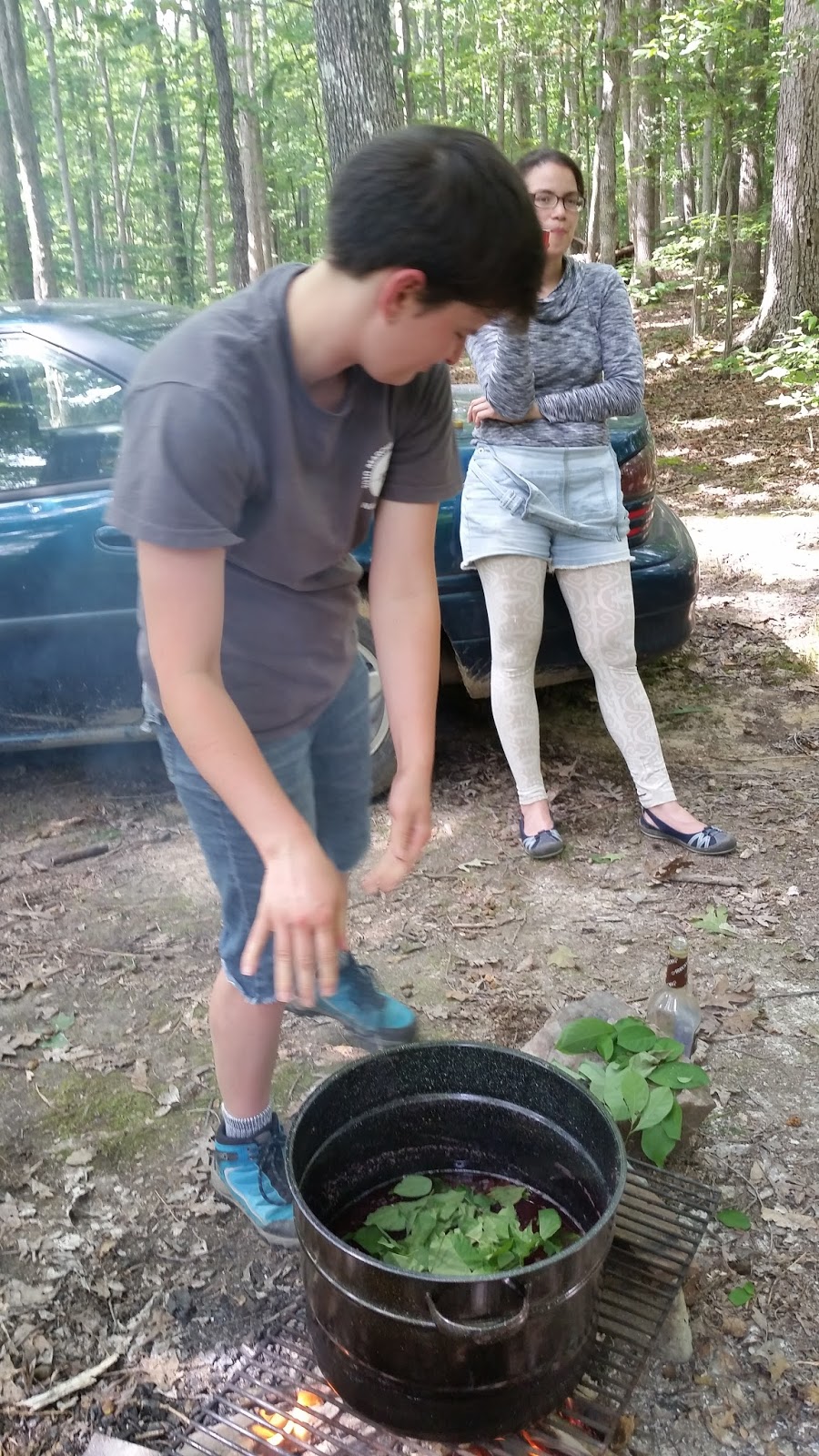
The ale brewing
over the campfire.
Mallory adding
the spice bush
to the ale.
Wild brewing was a blast and not just because Tim brought samples.  We started off the morning with a maple wine toast to the day, then jumped into brewing basics and beer brewing. It took some discussion, but the group finally decided on a Spice Bush Amber Ale. The students set off to find the spice bush from the previous day's class. Thankfully, we had a ringer who knew the property. A friend of Tim's was there to chaperon or I'd have been lost for sure. (I can get lost in my own small condo!) Mallory got to add the spice bush and pitch the yeast for the ale.

Moving on to the wine, we knew we'd be doing blackberries and all of us (except Tim - he's a sly one) braved the blackberry brambles, ticks, and sun to acquire our three pounds of wine in waiting. This wine will be amazing considering the blood, sweat, and tears we all shed for it.

Blackberry Spice Bush Mead
in the making.
Tim's hibiscus flower mead  rounded out our afternoon break and set the mood for the final project - mead!

The flavorings for the mead were a source of great discussion. We considered a great many things, even wild carrot, but finally settled on blackberry and spice bush. We had enough leftover from bottling that we all got a taste of the unfermented juice. It tasted fantastic. It is going to be a fantastic mead.

Mallory had enough fun in the class, she's all set to start brewing at home too. She's scouted out the local brewing store and priced out the basic supplies on Amazon already. She's got a steady supply of bottles courtesy of her also 22-year-old friends.

The class was also great fodder for things you don't normally hear in conversation:

  • "Kiddo, please get the blackberry branch off my butt."
  • "Burn that sum'bitch. Burn him. Burn him." (about a tick found on someone's pants)
  • "A tick will turn a die-hard pacifist into cold-blooded killer."
  • "This stick smells like french fries." (About the oak stick we stirred the ale with.)

Ale, Wine, Mead


Saturday, April 18, 2015

Hiking with Your Dog - Prep for Them Too!

Sasha loves a rainy walk
on the Mount Vernon Trail.
A lot of people take their dogs along on walks, hikes, and camping trips. They are great companions. I like my dog better than most people I know. Sasha accompanies me on all my day hikes. She's a miniature Schnauzer and not terribly helpful, but she is cute and she keeps me company. She also serves as a way to slow me down when I get into "walking is also exercise" mode.

When you take your dog out on hikes and trips, you need to prepare and protect them as much as you do yourself. Are you taking water for yourself? Don't forget your dog too. They are as susceptible to giardia and other water-borne illnesses as you are. Make sure you have potable water for puppy too.

Did you pack your lunch and some extra food just in case? Pack lunch and extra food for the doggie as well. You might consider a treat or two also. Why? Because they love you. That's why.

Because hiking and bushcraft is a recently renewed interest for me, I asked my vet if there are any additional steps I should take to protect my dog. Here are a few things she recommended:

First and foremost, keep them up to date on their vaccines and flea/tick medicine. All the standards, especially rabies, are a must. You should also make sure your dog is vaccinated for Lyme disease and leptosporosis as well. Leptosporosis is a bacterial infection that is transmitted in the urine of wild animals and infected water, soil, or mud. It is most common in tropical, sub-tropical, and wet environments. It loves places with stagnant water and wild animals. It is increasingly common in the US and Canada. Remember how I said the DC area used to be a swamp?

Sasha doesn't love
closed trails.
Every time your dog rolls in that foul and enticing smell on the ground puts them - and you - at risk. That's right. You too. Leptosporosis is zoonotic. It can be transmitted to humans as well as animals. Getting your dog vaccinated protects you both and frankly, the symptoms of this disease suck.

There is some debate over this vaccine, but talk to your vet. There can be side effects, as with any medication. My dog has never had issues with it and I always get the pets with  issues.

Dogs can also contract Lyme disease and other tick-borne illnesses, Be sure to give them their flea an tick medicine on time. There's even a chewable treat version out now that you only have to give your dog every three months. It also costs less than the equivalent number of doses of the smelly stuff you put on their skin. Ask your vet about it.

Also, if you use a retractable leash, consider using a normal, non-retractable leash instead. (I know some of you let your dog off lead, but in my area, dogs are required to be on leashes at all times.) Retractable leashes are nice. I have one for when Sasha and I walk the neighborhood. In the woods, they get tangled on branches and dogs tend to run off a bit more, then hit the end of the lead and they can get hurt when their necks get yanked back.

Hiking and camping are great fun. They are even better with your canine best bud. Just be sure you take all the safety precautions you'd take for yourself for them too.

Tuesday, April 14, 2015

The Next Bite - Spring Wild Edibles

Redbuds are pretty and taste good!
I got to take the next bite of wild edibles this past weekend at Tim MacWelch's Spring Wild Edibles class (Advanced Survival Training). I was excited for this one not only because the weather was (a lot) better than it was for the winter class in January, but also because I was really hoping to identify a few things on my own as well. (I did!)

We found several of the plants we were introduced to in the last class -  the common plantain, the seaside plantain, wild onions, and my favorite, the yarrow.

I learned that the weeds growing in between the pavers of my patio are Pennsylvania Bittercress, which I quite enjoy. I'd pull them up and put them in my salad if I didn't know what pesticides our homeowner's association sprayed on them. That, and the neighbor's dog pees on my patio to torment my dog. I'll find a safer place to forage.

The Pennsylvania Bittercress's cousin, Wintercress, I didn't enjoy so much. It was tasty at first, then the bitterness sneaked up on me and smacked me in the head. I'll eat it in a survival situation , but I don't think I'll be making it part of my everyday diet.

Spring Beauty
aka
The Fairy Potato
The actual Fairy Potato
My favorite of this class was the Spring Beauty, or as it was billed, the "elusive Fairy Potato". The flower is beautiful and incredibly delicate and if you dig it up, you get a tiny little potato. I was surprised how delicate the plant was.

I brought home two of the tiny potatoes and made itty bitty Fairy Potato Chips. It was a lot of work for a few tiny chips, but they were very good. I think if I cook with them again, I'll just cut them in half and drop them in a cup of soup or something.

We did find a small patch of wild strawberries. They'll be ready in June. Sadly, I won't be there for those, but maybe someone will get lucky and get a strawberry before the wild animals do.

One of the other bonuses of this class? We scoped out all the blackberries and other summer goodies are for the Summer Wild Edibles class and the Wild Brewing class - mostly the Wild Brewing class. That reminds me... I am off to empty three wine bottles for the Wild Brewing class so that we can refill them! (Don't worry. I won't empty them all at once.)

Salt and Pepper Fairy Potato Chips

Wednesday, March 11, 2015

Short Girl Bushcraft Tool Review - The Mora Companion Knife

I finally got to put my Mora Companion through its paces outdoors this past weekend. I trimmed a few branches off a tree, cut cord, and carved a notch in the hearth board of my bow drill set.  It was all smooth and easy. I even managed to do that all without injuring myself. Of course, my primitive skills instructor did forbid me to pay attention to any boys.

I really like the knife, with one little not-so-much.

The Good

The blade is great. Sharp right from the factory. Love that! A couple of my knives needed sharpening right out of the box, which I find terribly annoying. People buy knives to cut/carve/chop things. You can't do that (safely) with a dull knife. Why would any company deliberately leave their blades dull?

I also love the handle. Because of the rubberized, non-slip handle, it is very easy for me to hold onto. It's a slim handle to begin with, but the extra grip helps anyone with freakishly small hands control their blade. (My pistol coach told me I have the smallest hands he's ever seen, even for a woman.)

For a $15 knife, it is incredibly sturdy as well. It's solid and has a decent weight to the knife. For me, that means it has enough heft to be sturdy, but not be so weighty that it is tiring to use. It's well balanced.

Even if it weren't, for the price you won't be too sad if you lose it. One friend mentioned that he's lost two. He keeps replacing them because they are good knives. Of course, he gets nice brown and green knives that blend in with the leaves and grass beautifully. Mine might be an insanely obnoxious pink (magenta if you go by Mora's color chart), but if I drop it in a field, I can spot it from half a mile away.

The Not-So-Good

I've mentioned previously that I'm not a fan of the sheath. No need to unearth and beat that horse. It's already dead.

The only thing I didn't like about the knife is the spine of the blade. It has ever-so-slightly rounded edges so it won't create a spark on my fire steel. My Mora-losing friend mentioned that this is a change from his Moras. I don't need a knife that does every little thing, but I got a carbon steel-bladed knife so that it would work with a fire steel.

I can take a file to the spine and flatten it so that it will work with a fire steel, and eventually I probably will. I just shouldn't have to do that. It is a little bit of a bummer, but not enough for me to go looking for a different brand of knife.

The Summary

This is a great little knife that passes the short girl/little hands test. The key to passing the test is it has to do everything just as well as any other knife and be safely usable for a small-handed person. I know I make a fuss about having small hands, but it is very scary to have a knife slip out of your hand because the handle is too large and you just can't hold onto it.

Overall, the Mora Companion is a good utility knife. The sheath is standard for the inexpensive Moras. Someday, I might get a better sheath.  Someday sooner, I'll file down the back so the knife can be used to spark a fire too.


Sunday, March 8, 2015

Snowy First Steps to Wilderness Survival

At first I was afraid, I was petrified...

Okay, not really. I'd been looking forward to my primitive skills class from Advanced Survival Training and Instructor Tim MacWelch for a month now. For one, it was the first weekend in several that the weather didn't make getting outdoors completely miserable or life threatening. (People in Northern Virginia can't drive in snow and icy weather.) Second, I got to learn several basic skills that get me closer to my goal of being more self-sufficient.

I was most excited about learning to use a bow drill. We assembled our bow drill sets and all attempted to make an ember. I'd like to go on record stating that bow drills are hard. They are even harder in five inches of snow and a strong wind. I'm told that bow drill friction fires are difficult under any circumstance. That doesn't make me feel a lot better about not getting it right. Only one student managed to beat the elements and got an ember going.

I confess I got mad because my arm quit before I made an ember, so I used my fire steel and lit my tinder bundle. I wasn't going to leave without making fire, even if I kinda cheated. (Everyone knew, by the way.) At least I didn't use the lighter I had stashed in my backpack. I'll keep practicing with the bow drill. The damn thing won't beat me forever!

We need a lot more leaves
and a door!
The class was more successful at building shelters. It's a lot of work, but it was a lot of fun, especially scouting for good locations and materials. I like figuring out jigsaw puzzles and shelter building is a lot like a jigsaw puzzle. Find the right location. Place the pieces in the right direction and the right shape. Keep building until all the pieces are filled in.

We didn't complete the shelter because we had other things to learn, but we were pretty impressed with how much we could get done in a couple of hours, but it is obvious it would take much longer if we had been working solo. Primitive survival would definitely be a full-time job.

One of the other critical lessons of the day was the appropriate use of snow. It should definitely be used for snowball fights. Yeah, you can also melt it for water or if you had enough, build a snow shelter, but really, the best use of snow is pelting people with it.

We also learned basic flint knapping and the principals for signalling in a rescue situation. The best thing about Tim's classes is that everything is hands-on. We all built the shelters. Everyone made big and little rocks into useful tools. Everyone got a bow drill set and at least attempted to make fire. Everyone over the age of 21 got maple wine too.

Oh, Tim learned something too. If you dare me to squee like a teen-aged girl and ask for your autograph AND promise me maple wine if I do, I'll do it. I'll make you really sign the magazine too! (If I'm going to look silly, you're gonna sign!) The maple wine was fantastic, again! Thankfully, there was no video and to my knowledge, no pictures!

...I will survive!


Sunday, March 1, 2015

Knife Safety: Lessons in Attentiveness from a Teen-Aged Girl

Safety is key in almost everything you do, especially in bushcraft and survival. So is attentiveness. I learned those lessons as a teenager. (That was last year. If you don't believe me, ask my 21-year-old daughter. She will attest to it!) If your attentiveness fails, it is very likely your safety is compromised, and 16-year-old girls are easily distracted, especially by 16-year-old boys.

There are all kinds of rules for knife safety and whittling. Keep your knife sharp. Face the blade away from you. Take it slow and steady. 

Watch what you are doing should be high on that list. Maybe my dad thought it was so obvious it didn't need saying. I was his first (and only) daughter, so he didn't have the prior experience with raising teen-aged girls. 

Not the knife in question,
but this is one of my favorites now.
Both my parents grew up camping and generally being outdoors, so it was important that my brother and I had a similar childhood, right down to the whittling lessons. Gifted with a new pocket knife, I couldn't wait to impress my dad with natural talent at anything considered a "boy thing." I was big into the "anything a boy can do, I can do better" movement for a brief time. Then I realized there were more fun things to do with boys. (I might still be into this a little. I love the outdoors, guns, knives, and muscle cars. Also, high heels, Coach purses, make-up, and Eyeore.)

Which brings us back around to pay attention to the knife, not the boy.

The whole family was camping in Garmisch-Partenkirchen. There were a few other families in neighboring campsites. I'm fairly certain anyway. I'd been a bit fixated on the cute boy one campsite over so I wouldn't swear to anything in court. We were sitting around the camp fire when I decided to put the new pocket knife through its paces. Yes, I was trying to impress him. I didn't know if knife skills were what boys were looking for, but hey, it was worth a try.

Knife and stick in hand, I started whittling away, then I caught his eye. It might have been the knife that caught his eye, but I like my version better. Cue the smiles, embarrassed glances, hair flips, and Murphy's Law. I had flipped around the knife to trim off a small branch (I know, I broke another rule.) and the knife jumped on the tiny knot and right into the knuckle of my thumb.

The ensuing commotion was a sight to behold. I screamed, my mother screamed, my father yelled, my brother laughed. I lost track of the cute boy when my mother whisked me off to the station wagon to patch up my thumb.

Mom had plenty of experience patching up my brother, so she had the wound closed up pretty quickly. The ER doc was sufficiently impressed that he didn't even undo it and sent me off to nurse my wounded pride. I never did get to meet the boy.

To this day, despite mom's best ministrations, I have a 1/2 inch scar on my thumb to remind me of two things: Always point the blade away from you and pay attention to your knife, not the boy in the next campsite. 

Sunday, February 15, 2015

Short Girl Buschraft Tool Review - The *gasp*Bear Grylls*gasp* Multi-Tool

The flashlight, multi-tool, sheath, and fire steel. The paracord
is my addition to hook/carry the smaller tools since the
sheath is so awful.
I know as soon as you mention Bear Grylls, many bushcrafters, survivalists, and preppers scoff. Mention his line of Gerber tools and noses start to curl. I received one of the Bear Grylls Gerber multi-tool sets for Christmas. It has the flashlight, a multi-tool, and fire steel. (Yes, I see the noses turning. Chill.)

I actually quite like the multi-tool, but lets knock the little stuff out first. The flashlight is a flashlight. It's small and fits in my purse if I want it to. It's bright and it works. The fire steel also works just like it should. It makes nice, big sparks. Perfectly good. Okay, on to the big stuff.

Next to my thumb is the piece
that warps and makes it
difficult to get the tool free.

What Stinks 

The sheath. My previous comments on rigid. plastic cases still stand. They are uncomfortable on curvy women. This case is particularly bad though. The way the rubber strap attaches to the sheath warps the plastic sheath so that the tool is virtually impossible to get out. I had to pry the tool out one time after I left it in for a few days and cut my finger on the plastic. I can barely get the tool out with two hands when it isn't on my belt, let alone one-handed when it is on my belt. I can't quite get into words how much I hate this plastic sheath. It sucks. I'm looking for a new canvas one to use. Until then, the tool goes in my bag. It's a bit on the big side to be comfy in my pocket.

What is Great

The tool. Gerber makes great multi-tools, whether they have the Bear Grylls name on the side or not. I really don't care whose name is on it. I like it because it works for me. My hand is smaller than a Samsung Galaxy S5 phone. Tip of my fingers to the heel of my hand: 5.75 inches / 14.6 cm. Tiny. Most multi-tools are a little hard to hold onto. Gerber added a rubberized coating to this multi-tool to add a non-slip grip to the tool. That and they had to splash the Bear Grylls orange/gray all over the thing. It is easy to spot when you drop it.

That non-slip grip means that even if the tool is a bit too large for my hand, I can hold onto it. It makes the tool usable for people with small hands and like other Gerber multi-tools, it is very useful. I've used it around the house when I haven't wanted to get my tool box out. (Yes, I have a tool box. No, it isn't pink. Yes, it includes power tools and I know how to use them properly!) I've used it outdoors and it has done everything I asked of it thus far. I've not tried to cut down a tree or split firewood. That's not what it is for. Among other small tasks, I've snipped plants, fixed a bathroom cupboard door, and cut paracord. Like I said before, Gerber makes good multi-tools.

The Summary

If you can get past the Bear Grylls name on the side, this is a great multi-tool, especially if you an benefit from the non-slip grip. It is the only full-sized multi-tool I've handled that I don't struggle to hold onto. Toss the sheath into the trash though. It's beyond worthless. Really disappointed in Gerber for that one.  Overall, it passes the short girl usability test.


Wednesday, February 11, 2015

Is There a Height Requirement for Bushcraft & Survival?

I want to know if endeavor like those roller coasters at Disney World that say "You cannot ride this ride unless you are taller than this line" because I don't reach all of those lines. God stopped when I was perfect. I don't know what took y'all so long.

When it comes to bushcraft/survival, I'm not in a big hurry to accumulate a lot of gear. I want to get the right stuff and spread out the expense a bit. It took visiting multiple stores and an all day shopping trip to find a pair of hiking boots in my size. I would love to find a backpack that isn't taller than I am.

I know a lot of outdoor gear manufacturers and retailers are targeting women now. REI has an entire campaign around women in the outdoors. Yet, they still seem to think that all women are 5'6"/167 cm and built like Kate Moss. (Just FYI, no normal woman is built like her.) Some of us are short (I stopped at 5'/152 cm). We have hips and boobs. Some of us have more than others. That means straps can't always fall in the same places as a guy and need to adjust differently to accommodate the girls.

The handle is perfect.
The sheath, not so much.
 I found a Morakniv Companion knife that I really like. (Thanks +Chris Swanda / @ChrisSwanda!).  It will work quite well for now, but I imagine I will have to do some serious shopping around when I need anything more heavy duty. I have a hard time finding knives with handles that I can grip properly. Probably shouldn't have a blade go flying out of my hand 'cause I can't hang onto it. Seems like a bad idea anyway.

(Yes, I did get a pink knife. I wanted purple, but they didn't have purple. Instead, I picked pink so that if I hated it, I could send the knife to one of the two guys who recommended it and it would be PINK. Also, if I lose it in the grass or woods, it will be easy to find. And as Tim MacWelch / @timmacwelch pointed out, guys won't steal it.)

Oh yeah, knife makers, women have curves. Belt attachments that don't have a little bit of slack in them make tools and knives stick out from our hips and poke us in the waist. Rigid, plastic sheaths for knives and multitools get hung up on stuff because they don't lay flat on curvy surfaces. I made a paracord lanyard for my knife and I'll wear it around my neck a la Mors Kochanski when it is annoying me on my belt.

I know there is a lot of gear for which size doesn't matter. (Really, I mean it this time.) It seems like for the critical things, where safety and comfort truly matter, it is. (Okay, maybe it does matter.) I won't care if my sleeping bag is a foot too long. I do care that my backpack doesn't end around my knees.

As I try different products, I'll keep the short girls updated!

Saturday, February 7, 2015

Where Am I Going? (And Could Someone Please Give Me a Map?)

One of my least favorite things to do at work is our annual performance goals. Every day I go to work, I do my best and I work hard. I strive to do my job to the best of my ability. Part of me argues that should be enough, but I can also see the value in setting goals. It gives you a target to shoot for, and on any journey, you need at least two of the following three things: a starting point, a direction, and a destination. With any two of the three, you can derive the third. (I find it disturbing when I can talk myself into doing things I hate because it is good for me. Tea and cookies would be so much more fun.)

One of my favorite sources of information for bushcraft, Paul Kirtley (@pkirt), posted about joining the route to mastery and one of his suggestions was setting positive constraints for yourself when it comes to bushcraft. Essentially, setting goals. (I think he's in cahoots with our HR department. It's a conspiracy to get me to write the damned things. Thank goodness he didn't start in on SMART goals...) He threw out the added challenge of putting your goals out in public so that if you blow it, everyone will know. He said it much nicer than that, but he end result is the same.

I started off learning more about prepping/bushcraft/survival with the two vague goals: getting back to nature and learning. I'm a huge fan of knowledge for knowledge's sake. In the case of skills like fire making or identifying edible plants, books and blogs aren't enough. That was apparent to me about five pages into one of my books, so I found a class on wild edibles. I'm kinda hooked now. More learning. I wants it. Practice. I needs it.

(I have the misfortune of living in a condo in a suburb of Washington, DC, with a homeowners' association that objects to me starting fires on my patio. I think they're worried I'll set the golf course ablaze. Practice is a challenge.)

The trick is there are so many paths on the journey. Knife skills, shelter making, plants, natural navigation, and on and on. I can't run blindly down all of them, so I should probably pick a trail to start with. I thought about it a while and I need all of the basics to support honing individual skills. It doesn't do me any good to know all the edible plants in the woods if I freeze to death because I can't start a fire.

So, goal number one: Learn the bushcraft basics. Learn how to start a fire, build a rudimentary shelter, find my way out of a paper bag, improve my knife skills.

After that, I really need something to focus on. With such a wide array of topics to choose from, I thought it would be good to start with something for which I already have an affinity.

Goal number two: Hone my edible plant knowledge. This one dovetails with one of my existing hobbies. I love plants. I raise herbs, orchids, and African violets and if I could, I'd have a snake-free jungle in my house. Learning more about the flora around me is fun and I'm always looking for new plants to cook with. (Homeowners won't let me have a garden on my patio either.)

I have a third big goal, but I'm not quite ready to put that one out there, partially because it is heavily dependent on my soon-to-be-a-college-graduate daughter not getting more expensive, and partially due to security reasons. A girl can't give away all her secrets.